
At Asset Employment Group, we know hiring the right people is one of the biggest decisions your business makes. Before you choose a candidate, you need to choose the right hiring model.
For many employers, the question comes down to contract vs full-time employment.
Contract workers can help you fill roles quickly, handle seasonal demand, cover labor shortages, and complete short-term projects. Full-time employees can give your business long-term stability, stronger retention, and deeper knowledge of your operations.
The right choice depends on your workload, budget, timeline, industry, and long-term goals. In many cases, the best answer is not one or the other. It may be a mix of contract staffing, temp-to-hire, and full-time hiring.
Asset Employment Group helps businesses in Tulsa, Jacksonville, Oklahoma, Florida, Georgia, and Texas find dependable workers for manufacturing, light industrial, warehouse, clerical, construction, maritime, electrical, skilled trades, and office support roles.
What Is Contract Employment?
Contract employment is when a worker is hired for a specific period, project, season, or business need. In staffing, contract workers may also be called temporary employees, short-term workers, or contingent workers.
Businesses often use contract staffing when they need help fast but do not want to commit to a permanent hire right away.
Contract employment is commonly used for:
- Seasonal demand
- Production increases
- Warehouse and distribution spikes
- Construction projects
- Maritime and skilled trade work
- Clerical coverage
- Employee leave coverage
- Short-term labor shortages
- Special projects
- Trial periods before permanent hiring
For example, a warehouse may need 20 additional workers during a busy shipping season. A construction company may need electricians for a specific project timeline. A manufacturer may need extra machine operators when orders increase.
In these cases, contract staffing helps the business stay productive without adding permanent payroll too early.
What Is Full-Time Employment?
Full-time employment is when a worker is hired as a permanent part of the business. Full-time employees usually work a consistent schedule and may receive benefits, paid time off, retirement options, and long-term growth opportunities.
Full-time employees are often best for roles that require consistency, trust, training, leadership, or long-term business knowledge.
Full-time employment is commonly used for:
- Supervisors
- Managers
- Team leads
- Core production staff
- Office administrators
- Customer service roles
- Long-term operations roles
- HR and accounting support
- Quality control
- Client-facing positions
For example, a warehouse may use contract workers during peak demand but keep full-time supervisors to manage quality, safety, and daily workflow.
Contract vs. Full-Time Employment: Main Differences
The biggest difference between contract and full-time employment is commitment.
Contract workers give your business flexibility. Full-time employees give your business stability.
Here is a simple comparison:
| Factor | Contract Employment | Full-Time Employment |
|---|---|---|
| Best for | Short-term, seasonal, or project needs | Long-term business needs |
| Hiring speed | Usually faster | Usually slower |
| Flexibility | High | Moderate |
| Payroll commitment | Lower long-term commitment | Higher long-term commitment |
| Benefits cost | Often lower for the employer | Usually higher |
| Training investment | Usually shorter | Usually deeper |
| Retention | May be lower | Usually stronger |
| Workforce stability | Limited | Strong |
| Best fit | Temporary demand or uncertain workload | Ongoing roles and core operations |
Neither option is automatically better. The better choice depends on the job.
A temporary warehouse role during peak season may be perfect for contract staffing. A plant supervisor or office manager may be better as a full-time hire.
When Contract Staffing Makes Sense
Contract staffing is a strong option when your business needs people quickly or when demand may change.
1. You Need Workers Fast
Some businesses cannot afford to wait weeks or months to fill open roles. Delays can lead to missed deadlines, overtime costs, employee burnout, and slower production.
Contract staffing can help fill roles faster because staffing agencies often have access to pre-screened candidates.
This is especially useful for:
- Manufacturing companies
- Warehouses
- Distribution centers
- Construction crews
- Maritime employers
- Electrical contractors
- Office support teams
- Light industrial businesses
If your team is already stretched thin, contract staffing can help you keep work moving.
2. Your Workload Changes by Season
Many businesses do not need the same number of workers all year.
A warehouse may need more people during holiday shipping. A construction company may need extra labor during active project months. A manufacturer may need short-term workers when a large order comes in.
Contract employment helps you scale your team up or down based on real demand.
That can protect your budget because you are not carrying extra full-time payroll during slower periods.
3. You Have a Short-Term Project
Some roles are important, but only for a limited time.
Examples include:
- Equipment installation
- Inventory projects
- Office reorganization
- Construction phases
- Special production runs
- Shipping and receiving projects
- Skilled trade assignments
Hiring a full-time employee for a short-term need may not make sense. Contract staffing gives you the support you need without creating a long-term position.
4. You Want to Reduce Hiring Risk
A bad hire can cost your business time, money, and productivity.
Contract staffing lets you evaluate a worker’s reliability, skill level, attitude, attendance, and fit before making a longer commitment.
This is one reason many employers choose temp-to-hire staffing.
Need Workers for a Short-Term Project?
Whether you’re dealing with seasonal demand, a hard-to-fill role, or a temporary labor gap, Asset Employment Group can help you build a flexible staffing plan based on your workload and timeline.
Contact Asset Employment GroupWhen Full-Time Employment Makes Sense
Full-time employment is usually the better option when the role is central to your business and you need long-term consistency.
1. The Role Is Ongoing
If the work is steady every week, a full-time hire may be the better investment.
For example, if you always need a warehouse supervisor, payroll clerk, office coordinator, or quality control lead, hiring full-time may create more stability.
Full-time employees can learn your systems, understand your customers, and improve over time.
2. The Role Requires Extensive Training
Some jobs require detailed training before a worker becomes fully productive.
If your business needs to invest weeks or months into training, a full-time employee may make more sense than a short-term contract worker.
This is common in roles involving:
- Leadership
- Safety procedures
- Specialized equipment
- Client relationships
- Compliance requirements
- Internal systems
- Long-term process knowledge
The more training the role requires, the more important retention becomes.
3. You Need Strong Company Culture
Full-time employees are often more connected to the company’s goals, team structure, and daily operations.
They are more likely to build strong relationships, understand expectations, and contribute to long-term improvement.
This matters for roles where teamwork, leadership, accountability, and trust are important.
4. The Role Affects Customers or Operations Long Term
Some positions need continuity.
A customer service manager, account coordinator, operations supervisor, or HR lead should understand your company deeply. These roles often require trust and long-term decision-making.
For those positions, full-time employment is usually the better path.
Contract Staffing vs. Full-Time Hiring: Pros and Cons
Pros of Contract Staffing
Contract staffing gives employers more flexibility and speed.
Key advantages include:
- Faster hiring
- Easier seasonal scaling
- Lower long-term payroll commitment
- Less risk during uncertain demand
- Short-term project support
- Access to specialized workers
- Reduced pressure on current staff
- Ability to evaluate workers before hiring permanently
For growing businesses, this flexibility can make a major difference.
Cons of Contract Staffing
Contract staffing may not be ideal for every role.
Possible drawbacks include:
- Lower long-term retention
- More frequent onboarding
- Less company familiarity
- Less continuity for leadership roles
- Possible turnover during longer assignments
This is why contract staffing works best when matched to the right roles.
Pros of Full-Time Employment
Full-time hiring supports stability and long-term growth.
Key advantages include:
- Stronger retention
- More consistent performance
- Better company knowledge
- Stronger team relationships
- Better leadership development
- Greater accountability
- Long-term productivity gains
For core roles, full-time employees can become one of your strongest business assets.
Cons of Full-Time Employment
Full-time hiring also comes with higher responsibility.
Possible drawbacks include:
- Slower hiring process
- Higher benefit costs
- Greater payroll commitment
- More risk if demand slows
- More expensive bad hires
- Less flexibility during seasonal changes
Full-time employment works best when the role is truly needed long term.
Cost Comparison: Contract vs. Full-Time Employment
Cost is one of the main reasons businesses compare contract vs full-time employment.
But the cheapest option is not always the best option.
You need to look at the total cost, including hiring time, training, benefits, turnover, overtime, and lost productivity.
Contract Staffing Costs
Contract staffing may include hourly wages and staffing agency fees. In some cases, the hourly rate may look higher than a full-time wage.
However, contract staffing can reduce other costs, such as:
- Benefits
- Paid time off
- Long-term payroll obligations
- Recruiting time
- Overtime pressure
- Overstaffing during slow periods
- Administrative hiring work
For short-term or uncertain needs, contract staffing can be more cost-effective.
Full-Time Employment Costs
Full-time employment often includes more long-term costs.
These may include:
- Health benefits
- Payroll taxes
- Paid vacation
- Retirement contributions
- Workers’ compensation
- Training costs
- Recruiting costs
- Long-term payroll commitment
But full-time employees may also deliver stronger value over time through retention, efficiency, leadership, and institutional knowledge.
The real question is not “Which costs less today?” The better question is “Which option fits the role and reduces long-term risk?”
Temp-to-Hire: A Middle Ground Between Contract and Full-Time
Temp-to-hire staffing gives businesses a practical middle option.
With temp-to-hire, a worker starts in a temporary or contract role. If the worker performs well and the business still needs the position, the employer can offer a full-time job.
This model helps employers:
- Evaluate skills before hiring permanently
- Reduce bad hires
- Test reliability and attendance
- Confirm culture fit
- Manage uncertain demand
- Move strong workers into full-time roles
- Reduce turnover risk
For many businesses, temp-to-hire is the safest path when they need workers now but still want long-term hiring potential.
For example, a manufacturing company may bring in several temp-to-hire workers during a production increase. After 60 or 90 days, the company can offer permanent roles to the workers who show strong attendance, safety habits, and productivity.
Need Help Choosing a Hiring Model?
Not sure whether you need contract staffing, temp-to-hire, or direct hire support? Contact Asset Employment Group to discuss your open roles, hiring timeline, and workforce goals.
Industry Examples: Which Hiring Model Works Best?
Different industries use contract and full-time employment in different ways.
Manufacturing
Manufacturers often use contract workers for production increases, machine operation support, packaging, assembly, and short-term labor gaps.
Full-time employees are often better for supervisors, quality control, maintenance leadership, and long-term production roles.
Warehousing and Distribution
Warehouses often use contract staffing during shipping spikes, inventory projects, holiday demand, and large fulfillment periods.
Full-time employees are usually better for warehouse managers, logistics coordinators, safety leads, and team supervisors.
Construction and Skilled Trades
Construction companies often need contract workers for specific project phases. This may include general labor, electrical support, skilled trades, and project-based assignments.
Full-time employees may be better for project managers, long-term foremen, estimators, and operations coordinators.
Maritime
Maritime employers may need contract workers for project-based labor, specialized skills, or temporary workforce gaps.
Full-time employees may be better for long-term operational, compliance, and management roles.
Clerical and Office Support
Contract staffing can help cover front desk support, filing projects, data entry, leave coverage, and temporary administrative needs.
Full-time employment may be better for office managers, HR coordinators, payroll support, and roles that handle sensitive internal processes.
How to Decide Between Contract and Full-Time Employment
Use these questions before choosing a hiring model.
Is the work temporary or ongoing?
If the need is temporary, contract staffing may be the better choice.
If the work is steady and long term, full-time hiring may make more sense.
How quickly do you need someone?
If you need workers right away, contract staffing can often move faster than traditional hiring.
Is demand predictable?
If your workload rises and falls, contract workers can help you stay flexible.
If demand is stable, full-time employees may be a better investment.
How much training does the role require?
If the role requires heavy training, full-time hiring or temp-to-hire may be better.
Is this a leadership or customer-facing role?
Leadership and client-facing roles often benefit from full-time stability.
Are you unsure whether the role will stay permanent?
If you are unsure, temp-to-hire may be the smartest option.
Common Hiring Mistakes to Avoid
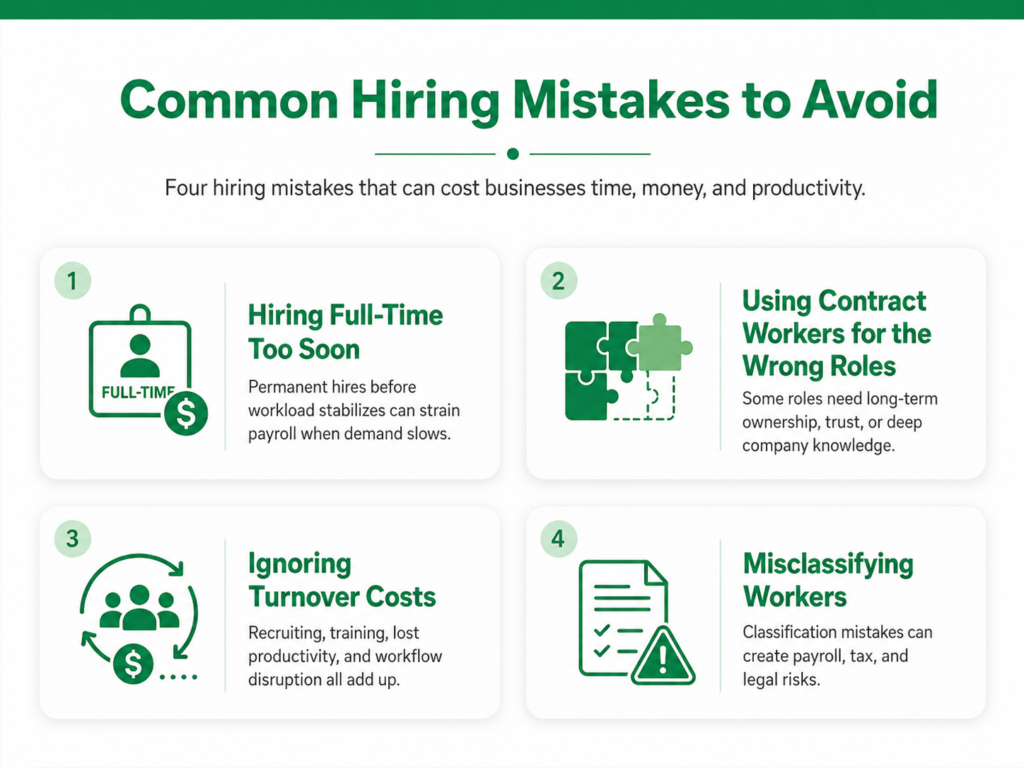
Even a strong hiring plan can become expensive when businesses choose the wrong staffing model. Here are four common mistakes to avoid.
Hiring Full-Time Too Soon
Some businesses hire permanent employees before the workload is stable. This can create payroll pressure if demand slows. Contract or temp-to-hire staffing can reduce that risk.
Using Contract Workers for the Wrong Roles
Contract staffing works well for flexible labor needs, but some roles require long-term ownership. If the role involves leadership, sensitive information, or deep company knowledge, full-time hiring may be better.
Ignoring Turnover Costs
A low hourly wage does not always mean lower cost. Recruiting, training, lost productivity, missed deadlines, lower morale, and workflow disruption can all add up.
Misclassifying Workers
Worker classification can create legal and payroll issues if handled incorrectly. Employers should understand the difference between employees, contractors, temporary workers, and staffing agency placements.
How a Staffing Agency Helps You Choose the Right Option
A staffing agency can help your business make better hiring decisions by matching your workforce plan to your actual needs.
Asset Employment Group supports employers with:
- Contract staffing
- Temporary staffing
- Temp-to-hire staffing
- Direct hire staffing
- Short-term project staffing
- Skilled trades staffing
- Light industrial staffing
- Clerical and office support staffing
- Manufacturing and warehouse staffing
Instead of guessing which hiring model is best, you can talk through your workload, budget, urgency, and long-term goals with a staffing team that understands your market.
This can help you fill roles faster and avoid costly hiring mistakes.
FAQ
What is the difference between contract and full-time employment?
Contract employment is usually temporary, seasonal, or project-based. Full-time employment is usually permanent and supports ongoing business needs. Contract workers give businesses flexibility, while full-time employees provide long-term stability.
Is contract staffing cheaper than full-time hiring?
Contract staffing can reduce long-term costs tied to benefits, paid time off, and permanent payroll commitments. However, hourly rates or staffing fees may be higher. The best choice depends on your workload, timeline, and hiring goals.
When should a business use contract employees?
A business should use contract employees when it needs short-term help, seasonal labor, project support, fast hiring, or flexibility during uncertain demand.
When should a business hire full-time employees?
A business should hire full-time employees when the role is ongoing, requires significant training, supports leadership, affects customers, or plays a key role in long-term operations.
Is temp-to-hire better than contract staffing?
Temp-to-hire may be better when you need workers quickly but may want to hire them permanently later. It gives you flexibility while allowing you to evaluate performance before making a full-time offer.
Can contract employees become full-time employees?
Yes. Many businesses use temp-to-hire staffing to move reliable contract workers into full-time roles after a trial period.
What are the disadvantages of contract employment?
Contract employment may lead to lower retention, more onboarding, and less long-term company knowledge. It works best for temporary, seasonal, or project-based needs.
How can a staffing agency help with contract vs full-time hiring?
A staffing agency can help you decide which roles should be contract, temp-to-hire, or direct hire. It can also help source candidates, reduce hiring time, and improve workforce planning.
Conclusion
At Asset Employment Group, we believe your hiring model should match your workload, budget, and long-term business goals.
If you need flexibility, fast hiring, seasonal support, or short-term project help, contract staffing may be the right choice. If you need long-term stability, leadership, retention, and deep company knowledge, full-time employment may be the better investment.
Many businesses benefit from using both. Contract workers help you stay flexible. Full-time employees help you build stability. Temp-to-hire gives you a practical middle path when you want to reduce risk before making a permanent offer.
Asset Employment Group helps employers in Tulsa, Jacksonville, Oklahoma, Florida, Georgia, and Texas find dependable workers for contract, temp-to-hire, direct hire, and short-term staffing needs.
Need help building the right staffing plan for your business? Contact Asset Employment Group to discuss your hiring goals and find the right workforce solution.