
At Asset Employment Group, we work with employers who need dependable workers, but not every role needs the same hiring model.
Some businesses need contract workers for short-term projects, seasonal demand, production spikes, or temporary labor gaps. Others need permanent employees who can support long-term operations, leadership, customer relationships, and company growth. For a related comparison, see our guide on contract vs full-time employment.
That is why understanding the difference between contract and permanent employment matters.
The right staffing model can help your business control labor costs, fill roles faster, reduce hiring risk, and build a more reliable workforce. The wrong model can lead to payroll pressure, turnover, missed deadlines, and unnecessary hiring delays.
In this guide, we’ll break down the five key differences between contract and permanent employment so you can choose the right option for your business.
What Is Contract Employment?
Contract employment is a work arrangement where an employee is hired for a specific period, project, season, or business need.
A contract worker may support your business for a few days, several weeks, a few months, or until a project is complete. In staffing, contract workers may also be called temporary workers, short-term workers, or contingent employees.
Businesses often use contract staffing for:
- Seasonal demand
- Temporary labor shortages
- Short-term projects
- Production increases
- Warehouse and distribution spikes
- Construction project phases
- Maritime assignments
- Clerical coverage
- Employee leave coverage
- Skilled trade support
For example, a warehouse may need extra workers during a shipping rush. A construction company may need skilled tradespeople for one project phase. A manufacturing company may need additional production workers when order volume increases.
Contract staffing gives employers flexibility without adding permanent payroll too early.
What Is Permanent Employment?
Permanent employment is a long-term work arrangement where an employee becomes an ongoing part of the company’s workforce.
Permanent employees often work regular schedules and may receive benefits, paid time off, training, and career development opportunities. They are usually hired for roles that support steady business needs.
Permanent employment often works best for:
- Supervisors
- Managers
- Team leads
- Long-term production roles
- Office administrators
- Customer-facing positions
- HR and payroll support
- Quality control
- Operations coordination
- Specialized long-term roles
For example, a warehouse may use contract workers during busy seasons, but keep permanent supervisors to manage workflow, safety, training, and quality control.
Difference #1: Job Duration
The first major difference between contract and permanent employment is how long the role is expected to last.
Contract Employment Is Usually Short-Term
Contract employment works well when the business need has a clear end date or uncertain timeline.
Common examples include:
- A 3-month warehouse project
- A seasonal shipping rush
- A temporary clerical role
- A construction project phase
- Leave coverage for an employee
- A short-term production increase
This model helps employers cover immediate needs without committing to a permanent position.
Permanent Employment Is Long-Term
Permanent employment works best when the role is part of the company’s ongoing operation.
Common examples include:
- A warehouse supervisor
- A full-time office manager
- A production team lead
- A customer service manager
- A long-term maintenance technician
- A payroll or HR coordinator
If the job will continue month after month, permanent hiring may be the better investment.
Employer Takeaway
Use contract employment when the need is temporary or uncertain. Use permanent employment when the role is essential to long-term operations.
Difference #2: Hiring Speed
Another key difference is how quickly employers can fill the role.
Contract Hiring Is Usually Faster
Contract staffing often moves faster because staffing agencies may already have access to pre-screened candidates.
This can help employers respond quickly to:
- Labor shortages
- Production delays
- Employee absences
- Sudden order increases
- Tight project deadlines
- Peak shipping seasons
For industries like manufacturing, warehousing, logistics, construction, and light industrial work, hiring speed can directly affect productivity.
If a shift is understaffed, the cost is not only an open position. It may also mean missed deadlines, overtime pressure, slower output, and higher stress on current employees.
Permanent Hiring Usually Takes Longer
Permanent hiring often requires more evaluation.
Employers may need:
- Multiple interviews
- Background checks
- Skills testing
- Culture-fit conversations
- Salary negotiations
- Benefit discussions
- Long-term planning
This process takes longer because a permanent hire affects the business for years, not weeks.
Employer Takeaway
If you need someone quickly, contract staffing may be the better option. If you need a long-term employee for a core role, a slower permanent hiring process may be worth it.
Need to Fill Roles Quickly?
Need to fill roles quickly without rushing into a permanent hire? Asset Employment Group can help your business find qualified contract, temp-to-hire, and direct hire candidates based on your workload and hiring timeline.
Contact Asset Employment GroupDifference #3: Labor Costs and Benefits
Cost is one of the biggest reasons employers compare contract and permanent employment.
But the lower-cost option is not always obvious.
Contract Employment Can Reduce Long-Term Commitments
Contract staffing may help employers reduce long-term costs tied to:
- Benefits
- Paid time off
- Retirement contributions
- Long-term payroll obligations
- Overstaffing during slow periods
- Internal recruiting time
- Excess overtime
In some cases, contract workers may have higher hourly rates, but the total cost can still make sense for short-term or seasonal needs.
For example, if a manufacturer only needs extra workers for 8 weeks, contract staffing may be more cost-effective than hiring permanent employees and then struggling to keep them busy later.
Permanent Employment Requires More Investment
Permanent employees often come with more long-term expenses, such as:
- Health insurance
- Paid vacation
- Sick leave
- Payroll taxes
- Retirement contributions
- Training costs
- Onboarding time
- Career development
These costs are not automatically bad. For the right role, they can be a smart investment.
A strong permanent employee may improve productivity, reduce turnover, support leadership, and bring long-term value to the business.
Employer Takeaway
Contract employment can help control short-term costs. Permanent employment may deliver stronger long-term value when the role is stable and important to daily operations.
Difference #4: Flexibility and Workforce Planning
Flexibility is one of the biggest advantages of contract employment.
Contract Employment Helps Businesses Scale
Contract staffing allows employers to adjust their workforce as demand changes.
This is useful when your business deals with:
- Seasonal demand
- Unpredictable workloads
- Project-based labor needs
- Economic uncertainty
- Large customer orders
- Temporary staff shortages
For example, a distribution center may need more workers during a busy shipping season but fewer workers once demand returns to normal.
Contract staffing helps the business stay productive without carrying extra payroll during slower periods.
Permanent Employment Supports Stability
Permanent employees support consistency.
They learn your systems, understand your standards, build relationships, and often require less supervision over time.
Permanent employees are especially valuable for:
- Leadership roles
- Customer-facing roles
- Safety-sensitive roles
- Long-term production teams
- Administrative operations
- Roles requiring deep company knowledge
A stable permanent team can improve communication, reduce training repetition, and strengthen workplace culture.
Employer Takeaway
Contract employment gives your business flexibility. Permanent employment gives your business stability. Many employers need both.
Difference #5: Employee Engagement and Retention
The final major difference is how each model affects engagement and retention.
Permanent Employees Often Build Stronger Long-Term Engagement
Permanent employees usually have a clearer path inside the company. They may see the role as a career opportunity, not just a short-term assignment.
This can lead to:
- Stronger loyalty
- Better teamwork
- Higher retention
- More leadership growth
- Deeper process knowledge
- Better customer relationships
For long-term roles, employee engagement matters. A committed employee can improve the team’s performance over time.
Contract Workers Help Maintain Productivity
Contract workers may not stay long term, but they can still play an important role.
They help businesses:
- Keep production moving
- Cover workforce gaps
- Reduce overtime pressure
- Support short-term projects
- Prevent burnout among full-time staff
- Respond to urgent labor needs
Contract workers are especially useful when the business needs reliable help now but does not need a permanent hire yet.
Employer Takeaway
Permanent employment is often better for long-term retention. Contract employment is useful for maintaining productivity during temporary or changing demand.
Contract-to-Hire: A Practical Middle Option
Some employers do not want to choose between contract and permanent employment right away.
That is where contract-to-hire staffing can help.
With contract-to-hire, a worker starts in a temporary or contract role. If the employee performs well and the business still needs the position, the employer can offer a permanent job.
Contract-to-hire helps employers:
- Evaluate skills before hiring permanently
- Test reliability and attendance
- Confirm workplace fit
- Reduce bad hires
- Lower turnover risk
- Fill roles quickly
- Build a stronger long-term team
This model works well for manufacturing, warehouse, clerical, skilled trades, light industrial, and office support roles.
For example, a company may bring in several contract-to-hire warehouse workers during a busy period. After 60 or 90 days, the employer can offer permanent roles to the workers who show strong attendance, safety habits, and productivity.
Not Sure Which Hiring Model Fits?
Not sure whether a role should be contract, contract-to-hire, or permanent? Asset Employment Group can help you discuss your hiring needs and build a staffing plan around your workload, budget, and timeline.
Contact Asset Employment GroupContract vs Permanent Employment: Quick Comparison
| Factor | Contract Employment | Permanent Employment |
|---|---|---|
| Best for | Short-term, seasonal, or project-based needs | Long-term business needs |
| Hiring speed | Faster | Slower |
| Flexibility | High | Lower |
| Stability | Limited | Strong |
| Benefits cost | Often lower for the employer | Usually higher |
| Training depth | Usually shorter | Usually deeper |
| Retention | Varies by assignment | Usually stronger |
| Best industries | Warehouse, manufacturing, construction, clerical, skilled trades | Leadership, operations, administration, customer support |
This comparison can help you decide which model fits the role before starting the hiring process.
When Should You Use Contract Employment?
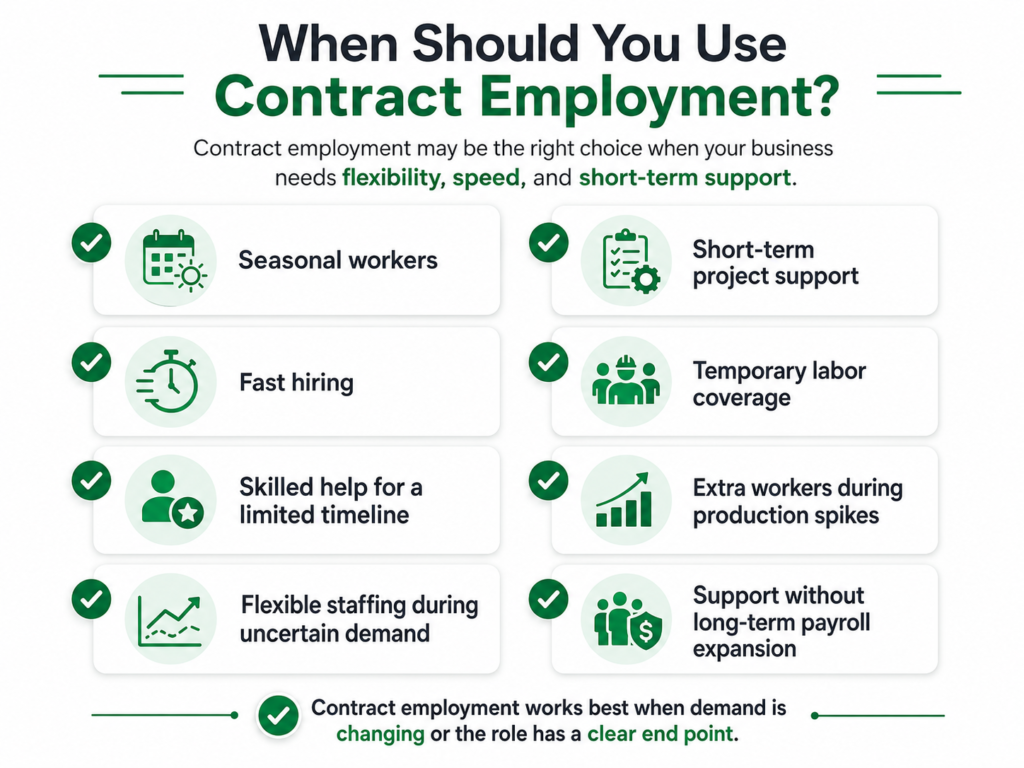
Contract employment may be the right choice if your business needs:
- Seasonal workers
- Short-term project support
- Fast hiring
- Temporary labor coverage
- Skilled help for a limited timeline
- Extra workers during production spikes
- Flexible staffing during uncertain demand
- Support without long-term payroll expansion
Contract employment is useful when demand is changing or when the role has a clear end point.
When Should You Use Permanent Employment?
Permanent employment may be the right choice if your business needs:
- Long-term stability
- Leadership development
- Strong employee retention
- Deep company knowledge
- Consistent customer relationships
- Long-term production support
- A reliable core team
- Employees who can grow with the company
Permanent employment is often the better option when the role supports daily operations and long-term business goals.
Common Mistakes Employers Should Avoid
Choosing Based Only on Hourly Cost
A low hourly rate does not always mean lower total cost.
Employers should also consider:
- Recruiting time
- Training time
- Turnover
- Lost productivity
- Overtime
- Missed deadlines
- Management time
The best staffing model is the one that reduces risk and supports business performance.
Hiring Permanently Before Demand Is Stable
Permanent hiring can create financial pressure if demand slows.
If your workload is uncertain, contract or contract-to-hire staffing may be safer.
Using Contract Workers for Long-Term Leadership Roles
Some roles need ownership, trust, and deep business knowledge.
Supervisors, managers, and key customer-facing roles may be better suited for permanent employment.
Ignoring Worker Classification Rules
Employers need to understand the difference between employees, contractors, temporary workers, and staffing agency placements.
Misclassification can create payroll, tax, wage, and legal risks. When needed, review official guidance from the IRS or Department of Labor, or work with a staffing partner that understands compliance.
How Staffing Agencies Help Employers Choose the Right Model
A staffing agency can help your business decide whether a role should be contract, contract-to-hire, direct hire, or permanent.
Asset Employment Group supports employers with:
- Contract staffing
- Temporary staffing
- Contract-to-hire staffing
- Direct hire recruitment
- Short-term project staffing
- Manufacturing staffing
- Warehouse staffing
- Light industrial staffing
- Clerical staffing
- Skilled trades staffing
- Maritime staffing
- Construction staffing
- Electrical staffing
- Office support staffing
A staffing partner can help you compare hiring speed, role requirements, labor costs, workforce demand, and long-term goals before you commit to one model.
FAQ
What is the main difference between contract and permanent employment?
The main difference is duration. Contract employment is usually temporary, seasonal, or project-based. Permanent employment is ongoing and supports long-term business needs.
Is contract employment better than permanent employment?
Contract employment is better for short-term needs, flexible staffing, seasonal demand, and fast hiring. Permanent employment is better for long-term roles, leadership, stability, and employee retention.
Is permanent employment more expensive than contract employment?
Permanent employment often includes benefits, paid time off, training, and long-term payroll obligations. Contract employment may reduce some of those costs, but the best option depends on workload, role type, and hiring goals.
Can contract workers become permanent employees?
Yes. Many employers use contract-to-hire staffing to evaluate workers before offering permanent roles. This helps reduce hiring risk and improve retention.
When should a business use contract staffing?
A business should use contract staffing when it needs workers for seasonal demand, temporary labor gaps, short-term projects, production spikes, or uncertain workload changes.
When should a business hire permanent employees?
A business should hire permanent employees when the role is ongoing, requires long-term training, supports leadership, affects customers, or plays a key role in daily operations.
How can a staffing agency help with contract and permanent hiring?
A staffing agency can help employers compare staffing models, find qualified candidates, reduce hiring delays, and build a workforce plan based on workload, budget, and long-term goals.
Conclusion
The difference between contract and permanent employment comes down to timing, cost, flexibility, stability, and long-term value.
Contract employment helps businesses move quickly, manage changing demand, fill temporary gaps, and complete short-term projects. Permanent employment helps businesses build stable teams, improve retention, strengthen leadership, and support long-term growth.
For many employers, the best staffing strategy includes both. Contract workers help your business stay flexible. Permanent employees support long-term consistency. Contract-to-hire can give you a practical middle option when you want to reduce risk before making a permanent offer.
Asset Employment Group helps employers in Tulsa, Jacksonville, Oklahoma, Florida, Georgia, and Texas find dependable workers for contract, contract-to-hire, direct hire, and short-term staffing needs.
Need help choosing the right staffing model? Contact Asset Employment Group today to build a hiring plan that fits your workload, timeline, and business goals.